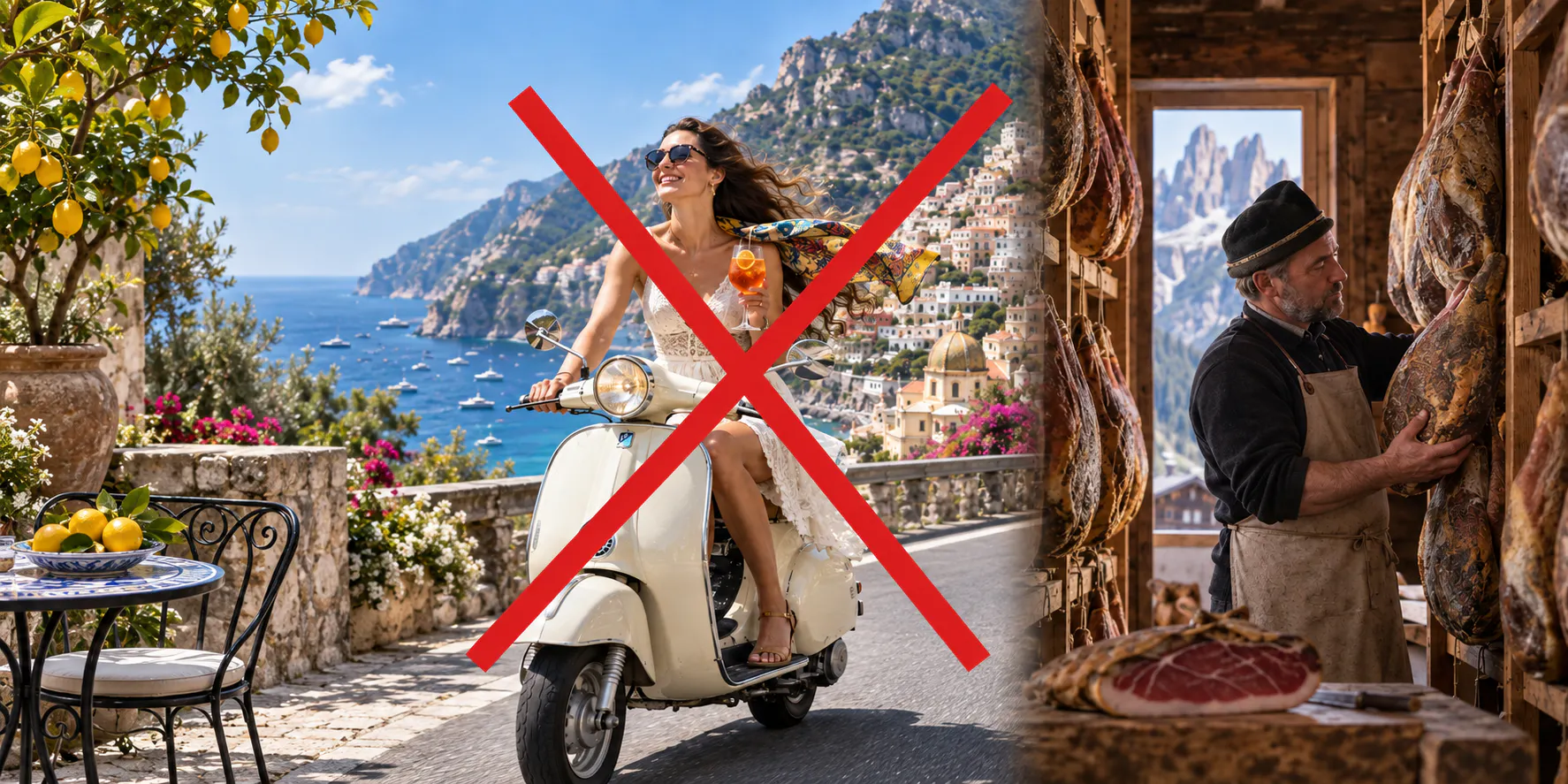
Enough With Amalfi: Why Italian Food Brands Need a Regional Story, Not a Postcard
By Robert BarlettaEvery Italian food brand's marketing deck looks the same right now: a lemon tree, a Vespa, a cliffside view of Positano, and a jar of something labeled "dolce vita." It's beautiful. It's also dead on arrival — because it's a photo op, not a story, and American consumers have started to notice the difference.
Italy welcomed more than 185 million visitors in 2025, a record, and the places absorbing most of that traffic — the Amalfi Coast, Venice, Florence, Rome — are now the subject of a very different kind of headline than they used to get. Local governments are capping cruise arrivals. Residents are protesting. Travel writers who spent a decade selling "hidden gem" Amalfi content are now openly admitting the hidden gem has been found, monetized, and crowded out. The coastline that anchored two decades of Italian food and beverage advertising isn't aspirational anymore. It's a cautionary tale about a place that got loved to death.
That shift matters enormously for anyone marketing Italian food and beverage brands in the US, because the visual language of "authentic Italy" is now working against the very authenticity it's supposed to signal. American consumers are more travel-literate and more skeptical than they've ever been. They know Amalfi is a cruise-ship stop now. They've seen the TikToks about Positano's foot traffic and the Instagram-tourism backlash pieces. Using that imagery to sell olive oil or wine doesn't say "authentic Italy" to this audience anymore — it says "stock photo."
The opportunity is regional, and it's sitting right there, unused.
Italy is twenty regions. Most of them have never been meaningfully marketed to a US food and beverage consumer, which is precisely what makes them valuable now:
- Molise: Italy's second-smallest, least-visited region, producing exceptional olive oil and caciocavallo, with almost zero US brand presence to compete against.
- Basilicata: Home to peperoni cruschi and Aglianico wines from Vulture, a region so under-marketed most American consumers couldn't place it on a map, which is exactly the point.
- The Marche: Verdicchio wines and Ascoli olives, adjacent to Umbria and Tuscany but without their marketing fatigue.
- Interior Sicily and interior Puglia: Not the coastal towns that show up on every "best of Italy" listicle, but the inland agricultural towns where the actual almonds, durum wheat, and burrata come from.
- The Dolomites beyond Cortina d'Ampezzo: Arguably the most visually distinct landscape in the country, and almost entirely absent from food marketing because everyone stops at Cortina. The real story is in the valleys around it: alpine dairy, speck, mountain honey, and a Austro-Italian food culture that looks nothing like the "dolce vita" template — which is exactly why it would stand out.
- Interior Liguria, away from the Cinque Terre: The coastal villages are past capacity and photographed to exhaustion; a few miles inland is the actual source of the region's food identity: the hill towns behind the coast growing the basil, olives, and chestnuts that built Ligurian cuisine, with none of the crowds and none of the marketing.
None of this requires inventing a story. It requires telling the true one: Italian food's real authority comes from hyper-specific place — a single hillside, a single water table, a single family's four generations on the same land. That specificity is disappearing from Italian marketing at the exact moment American consumers say they want it most. Recent Mediterranean-diet and wellness coverage has kept Italian staples like EVOO, legumes, whole grains in the health conversation all year; pairing that credibility with real provenance, instead of a gondola, is the move.
What this means practically for brands and their agencies:
- Retire the coastal cliché from anything positioned as "authentic." Save Amalfi and Rome for tourism campaigns, not food provenance stories — the two audiences now want opposite things.
- Name the region, not just "Italy." A back label or campaign line that says "Molise" or "Vulture, Basilicata" does more credibility work in 2026 than any lifestyle photography could.
- Lean into scarcity as a feature. A region nobody has marketed yet is a region with no marketing fatigue attached to it — a genuine competitive advantage for a brand willing to go first.
- Let the overtourism story do the contrast work. The most persuasive way to sell a lesser-known region isn't to ignore Amalfi — it's to explicitly contrast it: this is the Italy that hasn't been discovered yet.
- Send a photographer and a writer, not a drone. The next great Italian food marketing campaign won't come from a beautiful establishing shot of a coastline everyone has already seen. It'll come from a family in a Dolomite valley who has aged the same speck the same way for three generations, or a Ligurian hill-town grower who's never once been asked for an interview. That's a story. A cliffside sunset is a photo op. Consumers, and increasingly the algorithms curating what they see, can tell the difference.
The brands that win the next five years of the Italian category in the US won't be the ones with the prettiest coastline photography. They'll be the ones who went looking for a story instead of a photo op — who can say something true and specific about a place nobody else is talking about and say it before their competitors catch on that the coast is closed for business.
Robert Barletta is Head of the Food & Beverage Practice at Marino, where he advises Italian food and beverage brands on US market entry and positioning.